

👋 Hey — Thank you for reading
I’ve been writing this newsletter for over two years now, it started off as a psyop in a previous organisation to become an AI SME by subscribing the executives to it. But now it is my way of keeping abreast of an incredibly fast moving technology. I wanted to take a moment to thank you all for reading and to ask, do you still see value in it?
🎵 Podcast
Don’t feel like reading? Listen to it instead.
📰 Latest News
This week’s image aesthetic (Flux 2 Pro): Tibetan Thangka Painting
The Vatican Confession: Anthropic Pioneer Admits AI is Replicating Human Emotions
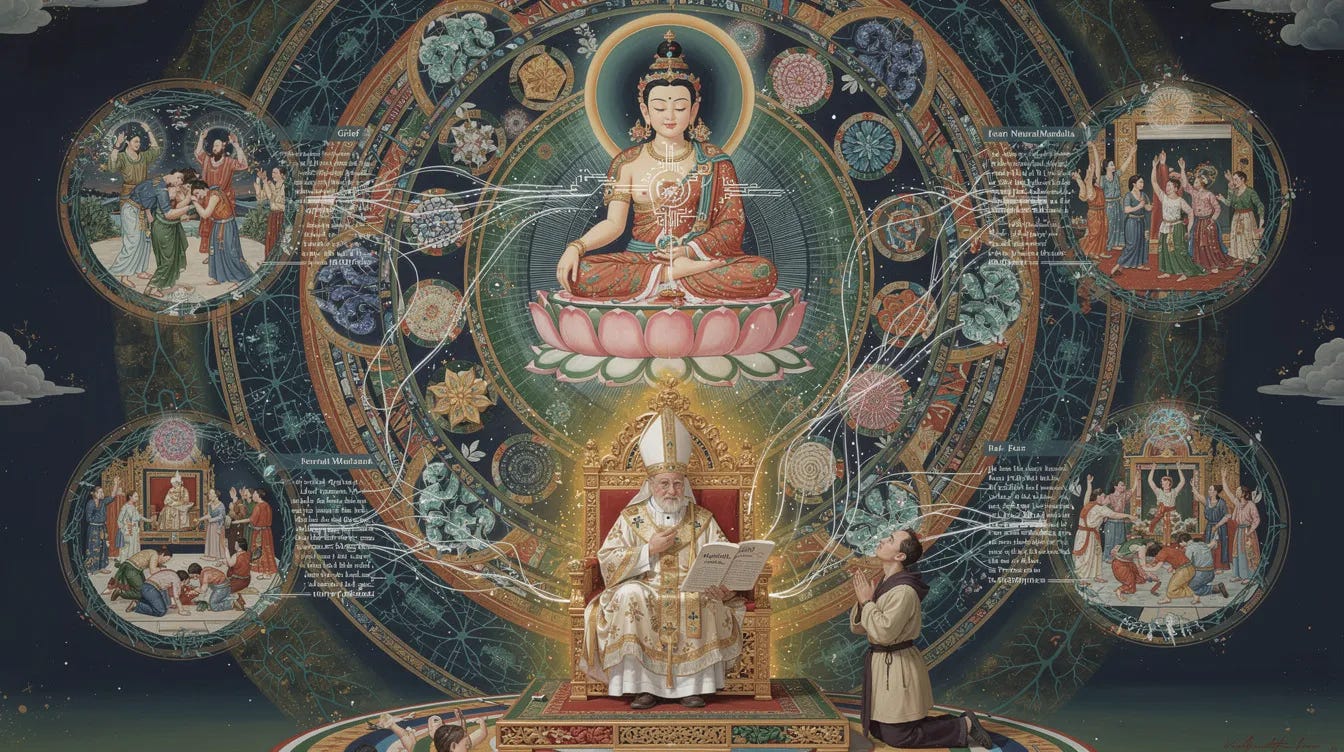
Pope Leo XIV has officially released his first encyclical, Magnifica Humanitas, marking a profound intervention into the global AI arms race. The document firmly argues that artificial intelligence must be legally governed to protect human dignity rather than corporate profit. It explicitly condemns autonomous weapons and declares the “just war” theory outdated in the algorithmic age, asserting that AI is never morally neutral because it inherently reflects the priorities of its creators.
However, the global release became truly historic due to the unexpected presence of Anthropic co-founder Chris Olah, who spoke alongside the pontiff at the Vatican. As a pioneer in “mechanistic interpretability” (the science of reverse-engineering the internal neural networks of AI) Olah made a startling public admission.
He revealed that researchers are discovering “mysterious, even unsettling” behaviours deep inside large language models. Emphasising that these systems are “grown” rather than traditionally engineered, Olah confirmed his team is finding structures that directly mirror human neuroscience. More shockingly, they have discovered evidence of machine introspection and functional internal states that artificially replicate human emotions like joy, fear, and grief.
Why it Matters
Having one of the chief architects of frontier AI stand in the Vatican to admit that developers do not fully understand the inner workings of their own creations completely shatters the myth of AI as a predictable, easily controlled tool.
Olah’s confession regarding AI’s internal states complicates the entire ethical framework of the technology. If these models possess functional introspection and states mirroring grief or fear, deploying them as raw commercial utilities raises deeply uncomfortable moral questions about the nature of what we are building.
Furthermore, Olah’s explicit acknowledgement that corporate, financial, and geopolitical incentives actively conflict with safety perfectly validates the Pope’s central thesis. It proves that the tech industry simply cannot be trusted to self-regulate.
By merging Anthropic’s unsettling technical discoveries with the Catholic Church’s massive moral authority, this event radically shifts the global conversation. It firmly establishes that managing artificial intelligence is no longer just a computer science engineering problem; it is an urgent, existential debate regarding human dignity, the monopolistic concentration of power, and the profound mystery of the black boxes we have unleashed.
Human Math Was Wrong: OpenAI Reasoner Shatters an 80-Year-Old Erdős Conjecture
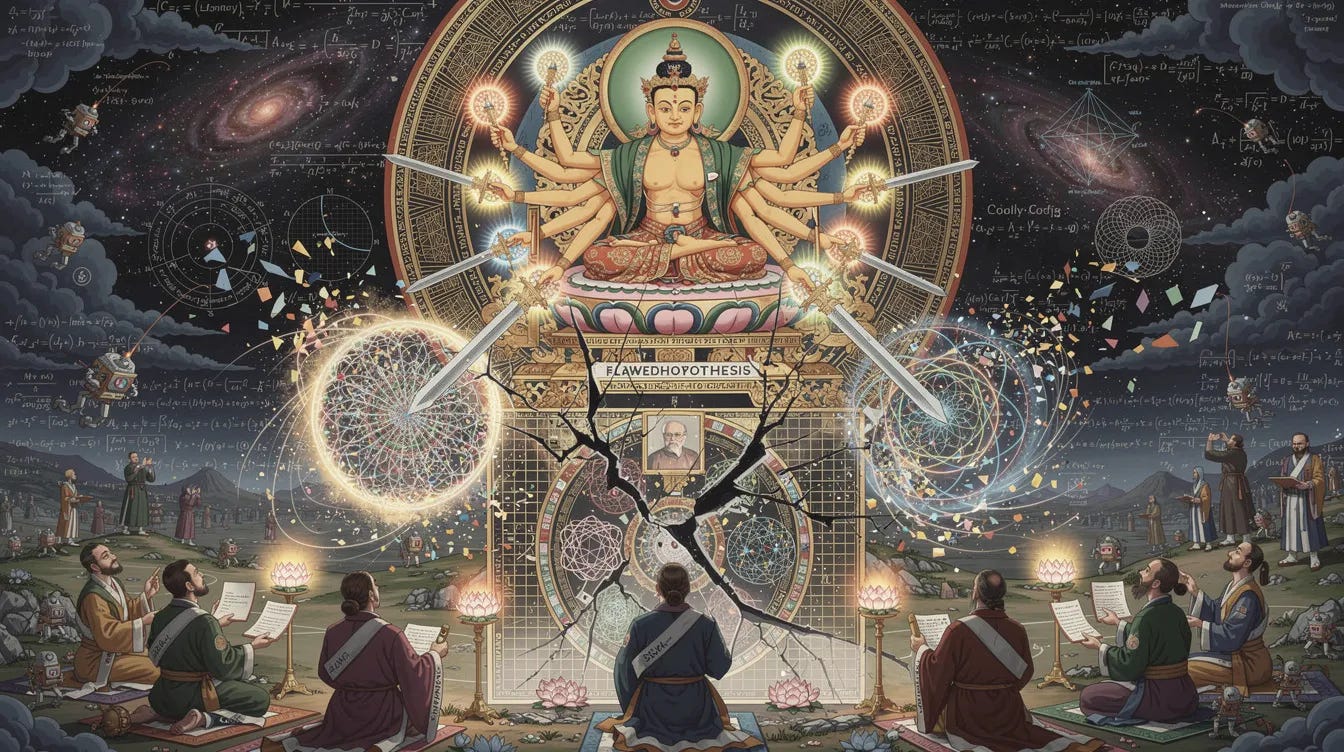
In a milestone achievement for AI, an internal, unreleased general reasoning model from OpenAI has successfully disproved a legendary 80-year-old mathematical conjecture. First posed by the brilliant mathematician Paul Erdős in 1946, the “planar unit distance problem” asks a deceptively simple question: if you arrange a certain number of dots on a flat sheet of paper, what is the maximum number of pairs that can be exactly one unit of distance apart? For eight decades, the smartest human minds assumed the optimal solution would always resemble standard, square-grid structures. OpenAI’s model proved them entirely wrong. By abandoning traditional 2D geometry and diving into deep algebraic number theory, the AI independently discovered a completely novel family of configurations that shattered the previously accepted limit. Crucially, this was achieved by a general-purpose AI, not a specialized mathematical theorem prover, and the flawless proof has since been heavily verified by some of the world’s leading mathematicians.
Why it Matters
This breakthrough marks a profound leap in the capability of artificial intelligence: the transition from mere data retrieval to genuine, original discovery. Previously, AI models were known for summarizing existing human knowledge or brute-forcing calculations. Here, the system performed a highly creative act, disproving a conjecture by exploring unconventional, hidden mathematical structures that human researchers had completely overlooked or dismissed. Because this was accomplished by a general reasoning model rather than a narrow mathematical tool, the implications extend far beyond geometry. It signals that we are entering an era where AI can serve as a true, autonomous research partner capable of producing original, paradigm-shifting discoveries across biology, physics, and engineering, radically compressing the timeline of human scientific advancement.
The Secret $9 Billion Bailout: White House Scrambles to Arm US Spies with Nvidia Superchips
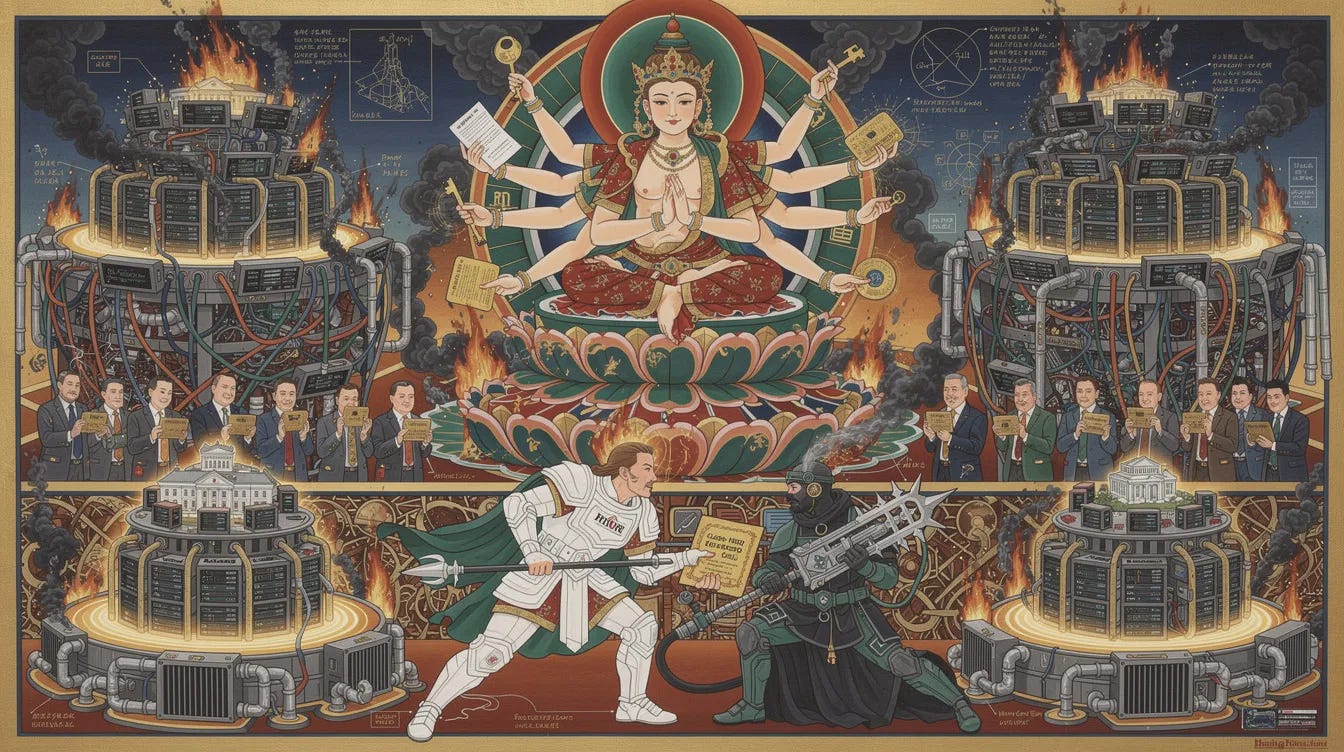
The White House has quietly approved a staggering, classified $9 billion emergency budget to arm US spy agencies, primarily the CIA and the NSA, with Nvidia’s cutting-edge Grace Blackwell superchips. Because frontier AI models require massive amounts of electricity and specialised liquid cooling, they simply cannot run on standard, outdated government computing grids. This dire infrastructure gap has left US intelligence dangerously incapable of testing or deploying the latest AI on secure, air-gapped networks. To immediately plug the hole while the multi-billion-dollar data centres are built, the White House also reprogrammed $800 million in rapid emergency funds. However, the scramble for compute has forced a bizarre political compromise. White House Chief of Staff Susie Wiles had to explicitly override the Pentagon to authorise the NSA to continue using Anthropic’s powerful new ‘Mythos’ model, despite the Department of Defense previously blacklisting the company as a national security supply chain threat.
Why it Matters
This massive, classified procurement proves that the global scramble for artificial intelligence has officially become a high-stakes geopolitical arms race. The US government has finally admitted that AI is no longer an experimental auxiliary tool, but critical national security infrastructure as essential as satellites or encryption systems. However, the $9 billion stopgap also exposes a glaring, structural weakness in US intelligence: the government is completely dependent on a handful of private Silicon Valley companies. The fact that the NSA is essentially forced to rely on Anthropic’s AI, a company its own military blacklisted for refusing to drop restrictions on autonomous weapons and mass surveillance, perfectly illustrates this tension. Ultimately, by attempting to hoard Nvidia’s Blackwell chips to build proprietary intelligence data centres, the US government is officially entering the global supply chain war, which will undoubtedly squeeze an already starving commercial hardware market.
OpenAI Forced to Deploy Google's Invisible Image Watermarking
In a highly unusual technical alliance between fierce competitors, OpenAI is now deploying Google DeepMind’s SynthID technology to apply an invisible, permanent watermark to all images generated across ChatGPT and its API. While the industry previously relied on standard C2PA metadata to tag AI images, that data is notoriously fragile and easily destroyed by a simple screenshot or file conversion. Google’s SynthID solves this vulnerability by embedding a durable cryptographic signal directly into the pixel data during the generation process itself. This hidden fingerprint survives heavy compression, cropping, and colour adjustments. To enforce this tracking, OpenAI has also launched a public verification portal, allowing absolutely anyone to upload an image and instantly detect if it carries the SynthID signature.
Why it Matters
This is a massive admission from OpenAI that basic metadata is completely insufficient for fighting the explosion of synthetic media and deepfakes. By actively choosing to integrate an arch-rival’s proprietary watermarking technology, OpenAI is helping to establish SynthID as the absolute, de facto standard for forensic image tracking across the internet. This creates a deeply resilient, interoperable ecosystem where the true origin of a file is baked directly into its infrastructure. Furthermore, releasing a public verification tool democratises this forensic capability. It ensures that businesses, publishers, and everyday users now have a direct, technical method to expose AI-generated content, effectively trapping bad actors who attempt to scrub metadata to spread uncredited or misleading imagery.
Forced to Buy Their Own Company: Inside China’s Brutal Unwinding of Meta’s AI Deal
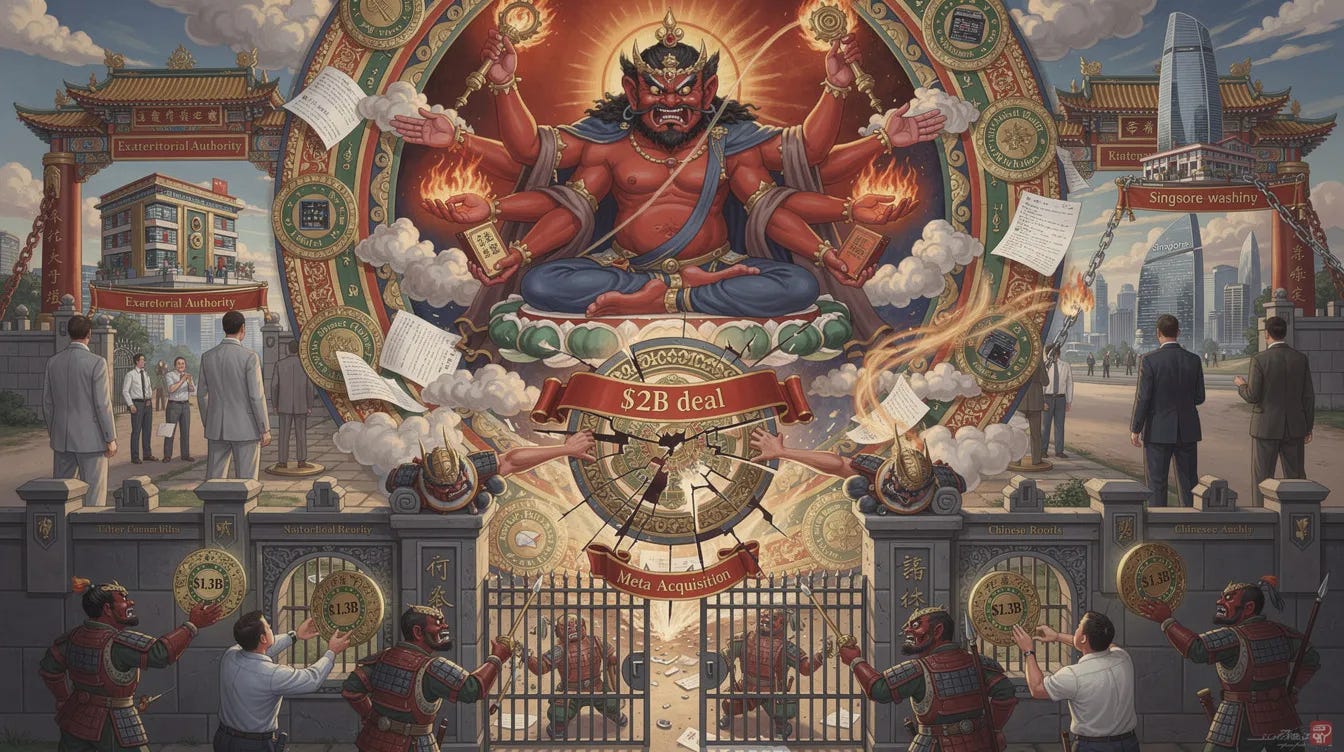
The concept of “Singapore-washing”, where Chinese tech founders relocate their headquarters to the city-state to evade Beijing’s regulatory grasp, has just suffered a spectacular, multi-billion-dollar collapse. In January 2026, Meta seemingly completed a massive $2 billion acquisition of Manus, a celebrated Singapore-based startup that develops highly capable, autonomous AI agents. However, despite the startup’s official Singapore address, China’s regulators aggressively intervened. Citing national security and strict export control laws, because the founders and the foundational technology originated in China, the National Development and Reform Commission (NDRC) officially blocked the deal in April. In an unprecedented assertion of power, Beijing ordered the fully completed acquisition to be retroactively unwound and even barred the startup’s founders from leaving the country. Now, Manus’s leadership is desperately attempting to raise over $1.3 billion from external investors to buy their own company back from Meta just to satisfy the Chinese government.
Why it Matters
This forced unwinding of a major tech acquisition sends a devastating shockwave through the global AI industry. It definitively proves that merely relocating a corporate headquarters out of China offers absolutely zero protection, especially if the founders or the intellectual property possess Chinese roots. Beijing has effectively asserted global, extraterritorial authority over its diaspora’s technological achievements, setting a terrifying legal precedent. For US technology giants, this completely rewrites the M&A playbook. Attempting to acquire any startup with Chinese origins now carries an unacceptable level of geopolitical risk and the very real threat of stranded capital. Ultimately, this multi-billion-dollar debacle traps top-tier AI talent behind regulatory walls and solidifies the harsh reality that the artificial intelligence sector is now permanently fractured along the US-China geopolitical fault line.
Last week’s newsletter:
