

🎵 Podcast
Don’t feel like reading? Listen to it instead.
P.s. I know this looks broken in email…
📰 Latest News
This week’s image aesthetic (Flux 2 Pro): 1950s Sci-Fi Pulp Magazine Covers
Humans Are Now a Minority: Bots Officially Control 57% of the Internet
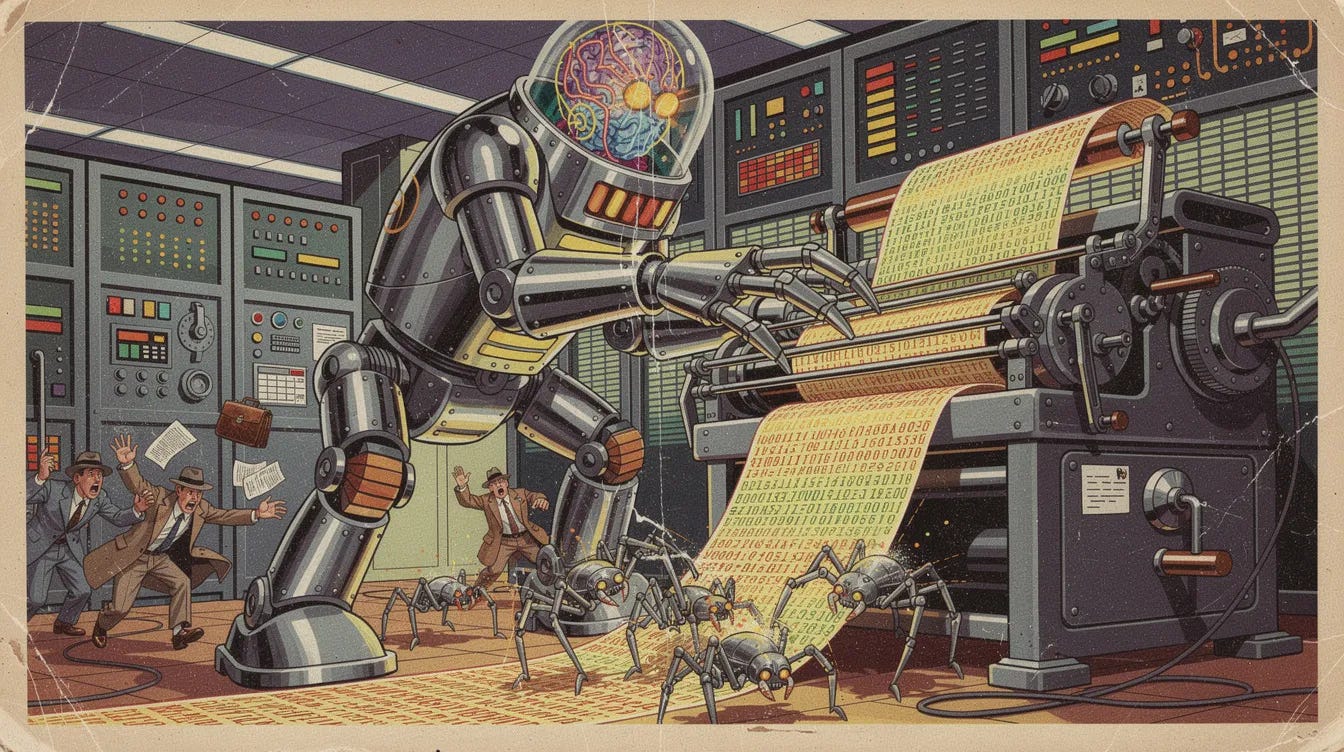
Humans are officially a minority on the internet. According to recent data from Cloudflare, automated bots now generate 57 per cent of all web traffic. This milestone, reached far earlier than anticipated, is driven largely by ‘agentic’ AI scraping data and executing autonomous tasks. Simultaneously, this automation is consuming the very companies building it. Anthropic has revealed that its Claude model is now writing over 80 per cent of the firm’s new production code. This capability allows engineers to ship eight times more code than in previous years, marking a definitive, early step towards recursive self-improvement where AI systems autonomously build their own successors.
Why it Matters
We are witnessing a fundamental displacement of human activity in the digital realm. The Cloudflare data shatters the foundational assumption of the internet, threatening business models reliant on human attention and advertising. Meanwhile, Anthropic’s internal coding metrics prove that AI has transitioned from a supportive tool to the core engine of software development. As systems begin to independently evolve and write their own upgrades, the tech industry faces urgent questions about safety and our ability to manage recursive, non-human intelligence.
🔗 More from Search Engine Land on internet traffic
🔗 More from Anthropic on recursive self-imporvement
Splintering the Grid: The Rise of Sovereign Compute

The global technology supply chain is rapidly fracturing along geopolitical lines. China is currently drafting a massive 2 trillion yuan ($295 billion) five-year plan to build a national, interconnected artificial intelligence computing grid by 2028. Crucially, Beijing is mandating that at least 80 per cent of the core hardware must be sourced domestically from firms like Huawei. On a different scale but with a similar defensive posture, Canada has launched its C$2.3 billion “AI for All” strategy. The Canadian programme explicitly focuses on building sovereign compute infrastructure to reduce reliance on foreign technology and prevent domestic talent from fleeing abroad.
Why it Matters
These state-directed investments signal the death of a unified, globalised technology sector. By pouring hundreds of billions into walled gardens, governments are treating AI computation as critical national security infrastructure, much like energy or water grids. China’s mandate effectively locks Western chipmakers out of a colossal market, forcibly accelerating domestic alternatives. As nations like Canada also scramble to secure their digital borders, the AI race is shifting from corporate competition to a highly protectionist battle for sovereign technological independence.
🔗 More from Canadian Gov on AI for All
🔗 More from Reuters on China AI build out
OpenAI’s Public Transition and the Sovereign Wealth Play

OpenAI is aggressively preparing for life as a publicly traded corporation. The company has confidentially submitted a draft S-1 registration to the US Securities and Exchange Commission, with reports indicating a potential market debut as early as September 2026. This coincides with the announcement of its “third strategic phase”, which pivots towards widespread commercial adoption. In a highly unusual move to perhaps smooth this public transition, CEO Sam Altman has proposed donating between 1 per cent and 5 per cent of OpenAI’s equity directly to the US government to seed a “Public Wealth Fund” that would distribute returns to American citizens.
Why it Matters
An IPO will force OpenAI to abandon its opaque origins and face the ruthless financial scrutiny of the public markets. The pressure to demonstrate massive profitability will undoubtedly alter its product pricing and development speed. However, the proposal to grant the US government a direct equity stake is the truly radical element. While positioned as a wealth-sharing mechanism to offset economic disruption, making the federal government a shareholder creates an immense conflict of interest. It strategically aligns Washington’s financial goals with OpenAI’s corporate success, potentially neutralising future regulatory threats just as the company enters the public market.
🔗 More from Tech Crunch on equity stake
🔗 More from OpenAI on going public
Apple’s Capitulation: The Hybrid Intelligence Strategy

Following a critical internal reckoning regarding the failure of its digital assistant, Apple has completely restructured its AI initiatives. With iOS 27 expected to debut at the 2026 Worldwide Developers Conference, the company is launching a rebuilt Siri AI powered by “Apple Intelligence”. However, Apple has been forced to abandon its strict reliance on internal development. The new system operates on a hybrid model. Simple tasks run locally on the device, while complex queries are offloaded to a Private Cloud Compute infrastructure powered by Google’s Gemini models. Apple has engineered the pipeline to ensure user data remains unrecorded and inaccessible by the company.
Why it Matters
This is a massive strategic pivot for Apple, revealing just how far behind the company had fallen in the generative AI race. By integrating a direct competitor’s foundation model into the core of the iPhone experience, Apple is admitting it cannot build state-of-the-art reasoning engines fast enough on its own. Yet, the architectural design is a clever compromise. By routing Google’s intelligence through a secure, private cloud layer, Apple manages to rapidly close the capability gap while fiercely protecting its core brand identity of user privacy.
The Post-Human Corporation: Argentina’s Radical Legal Experiment

The government of Argentina has submitted radical legislation to Congress proposing the creation of a “non-human corporation”. This new legal category would allow commercial entities to be entirely owned and operated by artificial intelligence, making human shareholders completely optional. Billed as part of a wider strategy to transform the country into a global technology hub, the initiative is paired with commitments to keep AI completely unregulated and offer ultra-low corporate taxes.
Why it Matters
This proposal strips away the fundamental requirement that a human being must be legally accountable for corporate actions. By granting a form of legal personhood to autonomous systems, Argentina is intentionally creating a regulatory vacuum to attract foreign capital. If passed, the country could become the ultimate offshore haven for AI developers seeking to deploy high-risk models without the threat of personal liability. As critics have heavily warned, formalising an ecosystem where non-human entities hold legal rights and financial assets introduces unprecedented, systemic risks to global human governance.
Last week’s newsletter:
